
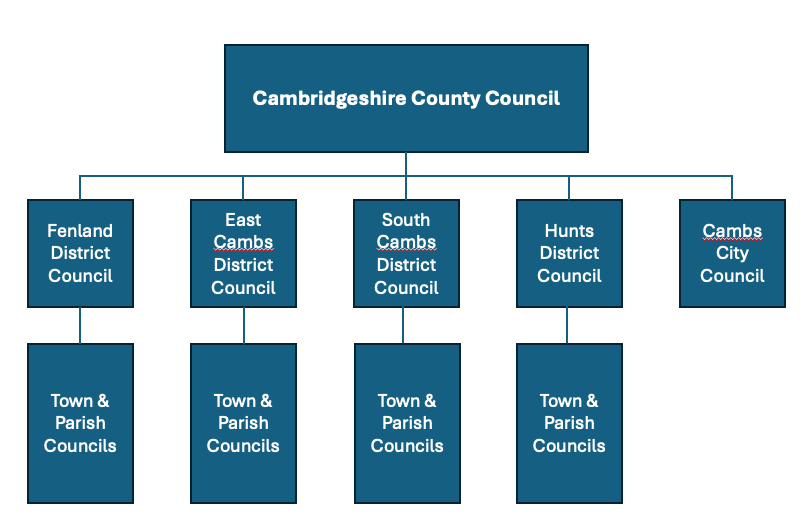
Have you ever been confused about how all the different councils in Cambridgeshire work, what they do and who is in charge? here’s a quick run-down.
Cambridgeshire County Council (CCC) was formed in 1998 and is responsible for all the ‘County Functions’ throughout Cambridgeshire, excluding the Peterborough area. (More on that later!).
Within the area covered by the County Council, there are five District/City Councils: Cambridge City Council, East Cambridgeshire District Council, Fenland District Council, Huntingdonshire District Council, and South Cambridgeshire District Council, responsible for the provision of District functions.
There are also over 260 Parish and Town Councils which operate in each District Council’s area (there are no town or parish councils in Cambridge City Council).
The County Council is responsible for the majority of functions:
- Children’s Social Services and Safeguarding
- Foster, Adoption and Corporate Parenting
- Adult Social Services and Safeguarding
- Education
- Early Years
- Home to School Transport
- Special Educational Needs and Disability Services
- Public Health
- Commissioning of Children’s, Adult and Public Health Services
- Highways Management and Maintenance
- Infrastructure Development
- Strategic Planning
- Community Services
- Adult Education
- Libraries, Culture and Archives
- Natural Environment and Archaeology
- Trading Standards
- Registration and Coroner Services
- Waste Disposal and Recycling
- Rural (Farms) Estate
The City and District Councils have fewer functions:
- Council Tax Collection
- Welfare and Benefits Services
- Economic Development
- Local Planning
- Housing
- Waste Collection
- Leisure and Recreation
- Environmental Health
Town and Parish councils have the least responsibilities:
- Looking after Community Buildings
- Open Spaces and Play Areas
- Allotments
- Play Areas
Then, working with Cambridgeshire County Council as a ‘Statutory Partner’, we have the Cambridgeshire and Peterborough Combined Authority (CPCA). Established in 2017 as a Mayoral Combined Authority for the Cambridgeshire and Peterborough region. The purpose of the Combined Authority is to lead the delivery of the Devolution Deal for Cambridgeshire and Peterborough. The CPCA is led by the directly elected Mayor.
The Combined Authority works with all the local councils, the Business Board (Local Enterprise Partnership), other local public services, Government departments and agencies, our universities, further education and skills providers and businesses to grow the local and national economy.
The Combined Authority is the statutory Transport Authority for the whole of the region and works closely with the two statutory Highway Authorities, Cambridgeshire County Council and Peterborough City Council. The Combined Authority leads the development and delivery of the Local Transport and Connectivity Plan for the region and the associated Transport and Infrastructure improvements, including leadership for public transport such as Bus services.
Other important Statutory Partners include:
- Cambridgeshire and Peterborough Integrated Care Board (ICB)
- Our local Integrated Care Board is known as NHS Cambridgeshire and Peterborough and they hold the legal responsibility to plan, commission and fund most of the NHS services that local people use
- The Emergency Services
- The Cambridgeshire and Peterborough Fire Authority is independent of any of the Councils, although a great deal of partnership working exists. It includes representatives of the County Council.
- The Police and Crime Commissioner (PCC) for Cambridgeshire is held to account by a Police and Crime Panel, which also includes representatives of the County Council as well as district councils.
- Cambridgeshire Constabulary works closely with the Police and Crime Commissioner, although the Chief Constable retains operational independence in law and has accountabilities to the Home Secretary and the Crown, in addition to local priorities from the PCC.
So, there you are – a very brief run-down on the structure of Local Government in Cambridgeshire.
As a candidate for the Electoral Division of Whittlesey South (there are eight Electoral Divisions in Fenland alone), if elected I will be in some small part responsible for decisions in all of the areas listed above, but the council operates on the basis of individual committees that focus on each area in depth, then report their recommendations to the full council for ratification. My areas of interest and the functions I hope to cover in depth are Infrastructure, Highways and Education. With Saxon Pit in the County and all the concerns that are raised over the businesses that operate there, I am hopeful that I will also be in a position to offer meaningful input into Waste Disposal and Management too.
I would urge you to support my candidacy and honour me with your vote on may 1st — I honestly believe that I am the best placed to represent the people of Whittlesey South, including the surrounding villages and rural areas that form the Division.